
Lift Heavy: Keep Your Muscle While You Lose the Weight
When you're in a calorie deficit, your body decides what to give up: fat or muscle. Strength training is how you tell it to keep the muscle. Download the Lift Heavy Compendium below for the full written program, and watch Dr. Strand's presentation on how to put it into practice.
Lift Heavy is the second of our Five Pillars of Health. Your provider will set your protein target and track your progress with body composition scans and your strength numbers.
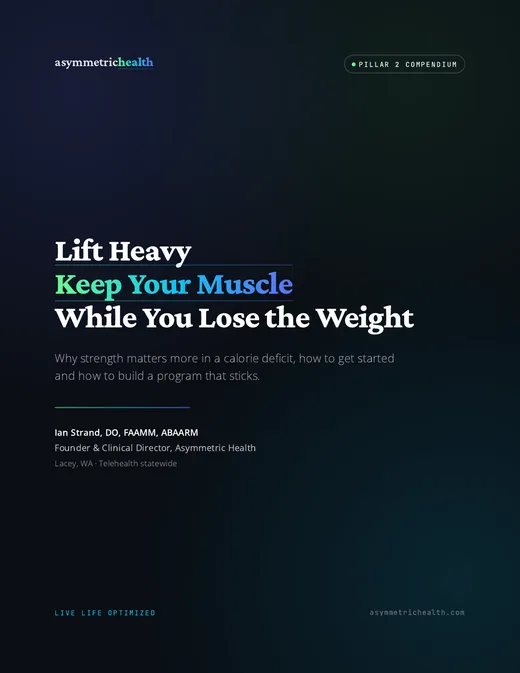
The Lift Heavy Compendium
Your complete written guide to Pillar 2: why muscle matters in a deficit, four ways to start (with local gyms in Lacey and Olympia), the six movement patterns, Workout A and B, progressive overload, training on a GLP-1, and the habits that make it stick.
PDF · 12 pages · free to download, save, or print
Watch the Presentation
Dr. Strand walks through why strength matters more on a GLP-1, four ways to get started, how to build a full-body program, and how to turn it into a habit. It runs about 30 minutes, so feel free to watch it in pieces.
Lift Heavy: keeping your muscle while you lose the weight. A presentation for Asymmetric Health patients.
The Short Version
Send the Signal, Supply the Substrate
Resistance training tells your body to keep its muscle. Protein gives it the raw material to rebuild. Do both and the weight you lose comes mostly from fat.
Full Body, Three Days a Week
Train the six movement patterns across Workout A and Workout B, alternating them. Four days a week is even better, and 45 to 60 minutes is plenty to start.
Two Hard Sets Per Exercise
A working set ends at or near failure, with no more than two reps left. Warm-ups don’t count. Then add a rep, a little weight, or slower reps over time.
Training on a GLP-1
Eat a little protein and carbohydrate before you train, drink more water than you think you need, and plan rest days around the day after your injection.
Never Miss Twice
Once is noise. Twice is the start of the wrong habit. Attach training to something you already do, and decide the day and time a week ahead.
When to Reach Out
If you get lightheaded or gassed mid-workout, rest longer between sets. If it keeps happening, message your provider through the patient portal.
This handout is general education and does not replace direct medical guidance. Follow the plan your provider built for you, and message your provider through the patient portal with any clinical questions.